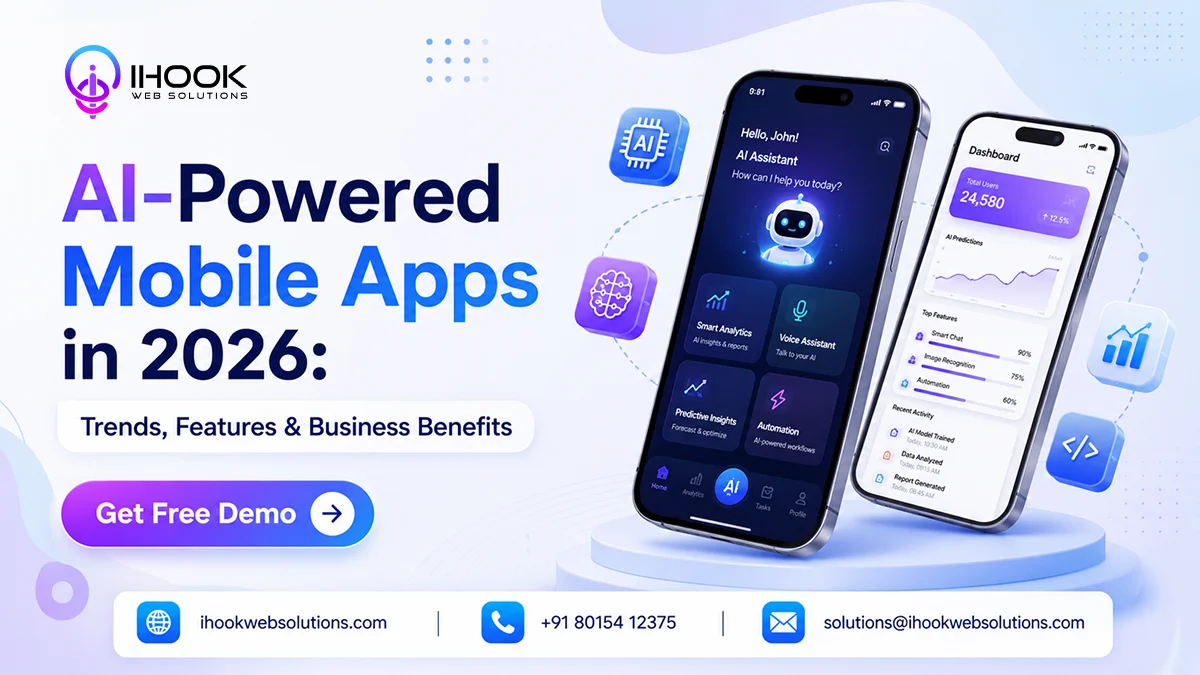
The mobile app industry is moving into a more intelligent and connected phase in 2026. Businesses are no longer building apps simply to have a presence on Android or iOS. Customers now expect applications to be faster, smarter, personalised, secure, and easier to use.
Artificial intelligence is playing a major role in this change. On-device AI, AI agents, intelligent recommendations, voice interaction, and adaptive app experiences are becoming important areas for developers and businesses to watch.
At the same time, applications are expanding beyond smartphones. Foldables, tablets, cars, and other connected devices are creating new opportunities for businesses to deliver consistent digital experiences.
So, what are the major mobile app development trends businesses should pay attention to in 2026?
1. AI-Powered Mobile Apps Are Becoming Mainstream
AI is no longer limited to standalone chatbot applications. Businesses are increasingly exploring ways to bring intelligent capabilities directly into their existing mobile products.
Popular AI-powered features include:
- Intelligent search and recommendations
- AI-powered customer support
- Voice-based assistance
- Image and document analysis
- Personalised content
- Automated workflows
- Predictive insights
The key is to use AI where it solves a genuine problem.
A simple AI feature that saves customers five minutes can be more valuable than a complicated AI system that nobody needs.
2. AI Agents Are Changing App Interactions
Traditional applications usually require users to complete tasks step by step.
AI agents are beginning to change this experience by allowing users to communicate what they want in a more natural way.
For example:
“Show my previous order and help me place the same order again.”
Instead of manually searching through different sections, an intelligent system could potentially help coordinate the required actions.
This creates a new opportunity for businesses to think beyond traditional screens and focus on automation, actions, and intelligent assistance.
3. Personalisation Will Improve Customer Experiences
Customers appreciate applications that understand their preferences without making the experience complicated.
For example, an e-commerce app can recommend relevant products, while a fitness app can adjust suggestions based on a user's progress.
Personalisation can help businesses achieve:
- Better engagement: Relevant content can encourage users to spend more time with an application.
- Improved customer experience: Users can find useful information without going through unnecessary steps.
- Stronger retention: A personalised experience can give customers more reasons to return.
The focus should always be on making the application more useful, not simply collecting more customer data.
4. Privacy & Security Will Be Essential
As applications handle more customer, payment, and business information, security becomes a fundamental part of the product.
A modern mobile application should consider:
- Secure authentication
- Biometric login
- Data encryption
- Secure API communication
- Permission management
- Fraud detection
- Safe payment processing
- Privacy-conscious data handling
Security should be planned from the beginning of the project rather than added after development is complete.
A secure application protects both the business and the trust it has built with its customers.
5. Apps Are Becoming More Adaptive
The mobile experience is no longer restricted to one smartphone screen.
Today, users may interact with applications through:
This means businesses need to consider how their application behaves across different screen sizes and environments.
An adaptive interface can provide a smoother experience without forcing users to learn a completely different layout on every device.
For businesses planning long-term digital products, this approach can make an application more flexible and future-ready.
6. Cross-Platform Development Remains Important
Businesses often want to reach Android and iOS users without unnecessarily increasing development time and maintenance costs.
Cross-platform technologies can be a practical solution for many applications.
| Requirement | Suitable Approach |
|---|---|
|
|
Cross-platform can be effective |
|
|
Reduces development effort |
|
|
Native may be preferable |
|
|
Depends on architecture |
There is no single technology that works for every business.
The right choice depends on the application's features, performance requirements, target audience, budget, and future roadmap.
7. Voice & Natural-Language Interaction
Users are becoming increasingly comfortable communicating with technology using natural language. Instead of navigating through multiple menus, users may simply ask the application what they need.
Imagine a banking application responding to:
“Show my pending payments.”
Or a service application handling:
“Find the nearest available technician and book an appointment tomorrow.”
These experiences can reduce unnecessary navigation and make applications feel more natural.
As AI assistants become more capable, voice and conversational interfaces are likely to become increasingly useful for specific business applications.
8. AI Is Reshaping E-Commerce Apps
E-commerce applications are another area where AI can create practical improvements.
A modern shopping application can go beyond displaying products and help customers discover what they actually need.
Businesses can explore features such as:
- AI product recommendations
- Smart product search
- Personalised offers
- AI shopping assistants
- Image-based product discovery
- Automated customer support
- Intelligent product suggestions
What Should Businesses Do in 2026?
Businesses don't need to follow every technology trend. Instead, start with the business objective.
A practical approach:
- 01. Identify the problem: Understand what customers or employees are struggling with.
- 02. Select the right technology: Use AI, automation, cloud services, or other technologies only where they add real value.
- 03. Build the core experience: Keep the first version focused on the features users actually need.
- 04. Test with real users: Feedback can reveal problems that are difficult to identify during development.
- 05. Improve continuously: Add advanced features based on customer behaviour and business requirements.
Businesses planning to build a future-ready application can explore our Mobile App Development Services to understand how modern mobile solutions can be created around specific business requirements.
Key Takeaway
The future of mobile applications is not simply about adding more features.
It is about creating smarter, faster, safer, and more useful experiences.
AI, AI agents, personalisation, adaptive interfaces, voice interaction, cross-platform technologies, and stronger security are all creating new possibilities for businesses in 2026.
The most successful applications will not necessarily be the ones using every new technology. They will be the ones that use the right technology to solve real customer problems.
For businesses, this makes 2026 an exciting time to rethink what a mobile application can do and how it can become a valuable part of long-term digital growth.
FAQ
1. What are the top mobile app development trends in 2026?
AI-powered apps, AI agents, personalisation, adaptive interfaces, voice interaction, stronger security, and cross-platform development are among the key trends.
2. How is AI changing mobile apps in 2026?
AI is making apps smarter through personalised recommendations, intelligent search, automation, voice features, AI assistants, and predictive insights.
3. Why is mobile app security important in 2026?
Mobile apps handle increasing amounts of personal and business data, making secure authentication, encryption, privacy, and safe API communication essential.
4. Are cross-platform apps still a good choice in 2026?
Yes. Cross-platform development can be a practical option for businesses that need Android and iOS applications while managing development time and costs.
5. Should businesses invest in mobile apps in 2026?
Yes. A well-planned mobile app can improve customer engagement, simplify business processes, support automation, and create new digital opportunities.